


How Fast Is Fast?

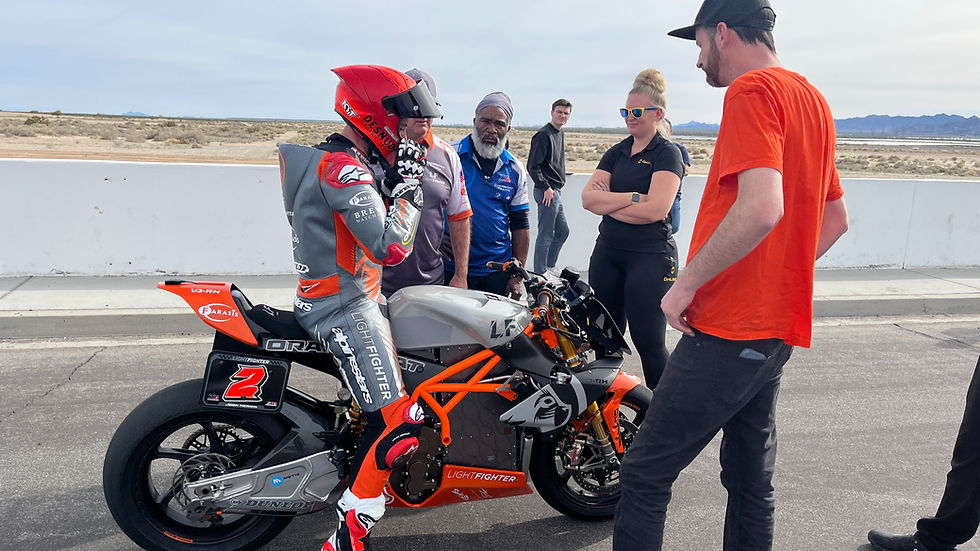
Talk around the Lightfighter office this week has centered on the pace we showed at our recent private test at Chuckwalla Valley Raceway with the OrangeCat Racing team.
Josh Herrin and Kaleb de Keyrel demonstrated strong speed at the desert track, with lap times that would have been more than competitive during the CVMA race weekend that had just preceded our test under similar conditions. They were fast, but how fast is fast?
Is fast a single flying lap, or consistency over race distance? Is it only fast if it’s done on worn slicks, or does it still count if a qualifying tire is sacrificed at the altar of speed?

In the case of an electric motorcycle, the question becomes even more complex. Is a lap time fast if it’s achieved at the lower end of the battery’s state of charge, when power output is reduced? What if the battery is cooled beforehand, and thus more thermally resistant than usual?
A considerable amount of lunchtime conversation revolved around exactly how fast we were at Chuckwalla, and how we should frame those results when sharing them publicly.
Heading into Daytona, every team wants a little buzz around their season’s prospects. Who will be the ones to watch? Who are the favorites, and who are the underdogs? For Lightfighter, the stakes may be slightly higher than for most.
MotoAmerica is the proof in our pudding. Our unifying goal is to build the next generation of road racing motorcycles, the machines that will replace the current meta with a new standard in performance. Simply put, we need to show that riding electric means riding fast. Faster than anyone else.
But Daytona is not a friendly place for an electric motorcycle company to make its professional racing debut. In fact, it’s probably the most demanding circuit in North America for an electric platform. This high-banked crucible demands a relentless supply of horsepower just to stay competitive to the finish line.
Daytona International Speedway will push our Lightfighter V3-RH race bikes to their absolute limits. And while you learn more from failure than success, failure as a first-impression is a poor introduction to the MotoAmerica paddock. No pressure.
So, while the talk this week has been about how fast we were, the work this week is about going faster tomorrow.
Constant development drives our actions this week, and in two weeks’ time, we’ll be back at the track, this time at Podium Club, trying to go fast again.


I appreciate the authenticity of this blog post. Lightfighter is doing its best to prepare for stepping into the unknowns for racing at the national level and at Daytona. Many scientific and technical questions are on the table, I'm excited to learn the answers and be along for the journey!
Can't wait to see how this performs, especially on the tighter tracks. Daytona doesn't really sound like the perfect track to make the debut given the power swapping nature of it - hope you can go the distance!
I am not familure with this race series. What difference in bike configuration is there between the superbike classes. Is there anything else other than no fairings and high bars? Will this be the only race series that you will run? Why do you like the Hooligan class better other than your bike looks really tough! It looks like the bikes at Pikes Peak.
When is the Daytona race? What's the format? Interesting challenge!